
The System is the Risk
The Waikato Hospital inquiry exposed catastrophic failures. It also revealed what happens when disability support, mental health services, and healthcare are stretched far beyond their limits.

I’ve been trying to write this post for several weeks now. Every time I get so far and then I need to go for a long walk, or have a cry, or a stiff drink. This topic is deeply personal to me, because I keep thinking about my wonderful, delightful daughter, and what it would be like for her to experience this horror.
I’m not going to lie. I am quietly terrified. My now 13yo is growing fast. She’ll be an adult soon enough. I am scared for what the future may hold for her. Hopefully this series (I don’t think I can fit it all into one post) will help explain for everyone else just how poorly resourced, badly trained, and inhumane our mental health sector is when it comes to disability.

Last year there was this case where local police handcuffed a non-speaking autistic child, took her to Waikato Hospital, misidentified her as a missing 20yo adult, and pumped her full of anti-psychotic drugs.
The case deeply resonated with me. I’d seen the family desperately trying to find their missing daughter, sharing her face across various Facebook groups. Their daughter was similar in age and looks to my own child. It was all too easy to imagine this happening to our daughter, which was frightening and left me feeling ill. I wrote this at the time:

Recently, the full inquiry and reporting into the incident was released, with some solid media attention:
Major failures led to autistic 11-year-old being sedated in adult ward, two reports find | RNZ
Mental Health Minister Matt Doocey seeks meeting with family of sedated Waikato girl to apologise | Waikato Times
Woman 'disgusted' her autistic sister, 11, restrained and injected | One news
The reports make for grim reading. I found it tough, reading about this poor child, curled up in a hospital bed, hands over their ears, unable to speak, incredibly distressed - and all the health professionals and police and adults were far too busy to take the time needed to provide care. There was no attempt to find the family and limited effort to ensure this child was okay.
I can’t help but think of my own child, a lovely kid, who finds it incredibly difficult to talk to strangers. I think of her, curled up in a ball, unable to speak, clearly in distress, and wonder what ED staff and police and then mental health staff would do to her.
I read about the nurse who (correctly) identified that this was a child, and the way the police onsite ran roughshod over those observations as they reached for a quick fix instead. There was more effort put into absolving themselves from responsibility than there was put into finding out who the child was. The lack of care horrifies me. There are an increasing number of autistic children growing up here, in Aotearoa New Zealand. Do all the adults we depend upon to provide care for disabled persons treated them with the same disregard when they think no-one is looking?
In the formal reports there is a lot of ducking and diving. The professionals and adults do their level best to avoid responsibility. Apparently nobody is directly to blame - despite neither the police nor the hospital formally filing an incident report until after journalists started asking questions. Similarly, there was no follow up or checking in by either organisation - until journalists starting asking questions. Did they think the family too poor and too brown to be worth caring about? Did they assume the family were ignorant of their rights and thus could be easily dismissed?
What is rather absent from these reports is the direct impact of inadequate funding levels, and how this leads to stressed, busy staff who are not supported by administrative mechanisms and practices. Consistent underfunding contributes to an unsafe environment. This is having catastrophic flow-on impacts for people - just recently a man died in the ED (Waikato Hospital) while waiting to see a Dr, and a disabled women died while en route to another regions hospital after being told it was a 24 hour wait at her closest ED.
Coming back to people with intellectual/learning disabilities, the situation is so dire, 5 clinicians took the extraordinary step of writing an editorial for the New Zealand Medical Journal back in February 2025:
Intellectually disabled people in residential care were being moved between homes because providers could not afford to pay for them, which was especially stressful for autism spectrum disorder patients moving from small, quiet flats into larger ones.
A combination of factors related to the funding changes has led to a rise in violent and suicidal behaviour, resulting in more presentations to emergency departments.
All of these factors were leading to pressure to increase the prescribing of anti-psychotic and sedative medication to moderate difficult behaviour – reversing years of progress in reducing medicalisation and institutionalisation.
Professor Richard Porter, a psychiatrist and lead author of the editorial, said: “I’ve worked in the NHS in the UK for about 10 years and in New Zealand for about 25 years, and honestly, this is the most inhumane change I have seen in my career.”
Not less than a month after this was published, an 11-year-old child was injected (twice!) with anti-psychotic drugs by staff at the Henry Bennett Centre in Hamilton, as this was an easier and quicker way to manage her distress than doing what was right (or even best practice). If the girl had been the 20yo they thought she was, we would never have heard about this - she would have received the exact same treatment and nobody would have batted an eyelid or complained or insisted staff do better. Let me say that again - injecting intellectually disabled adults with anti-psychotics to sedate them has become so routine staff did it immediately on arrival.
Following the release of the report into this specific incident, the Minister for Mental Health has apologised. Everyone is suitably horrified and is making all the kinds of noises one would expect. Yet neither Doocey, the Health Minister, nor the PM has made any commitment to ensuring ongoing sustainable funding (this would necessitate a substantial increase), or to providing adequate early intervention for families of disabled children, or to ensuring adequate administrative support for hospital staff, or to providing funding for they types of on-the-ground changes that make a tangible difference.
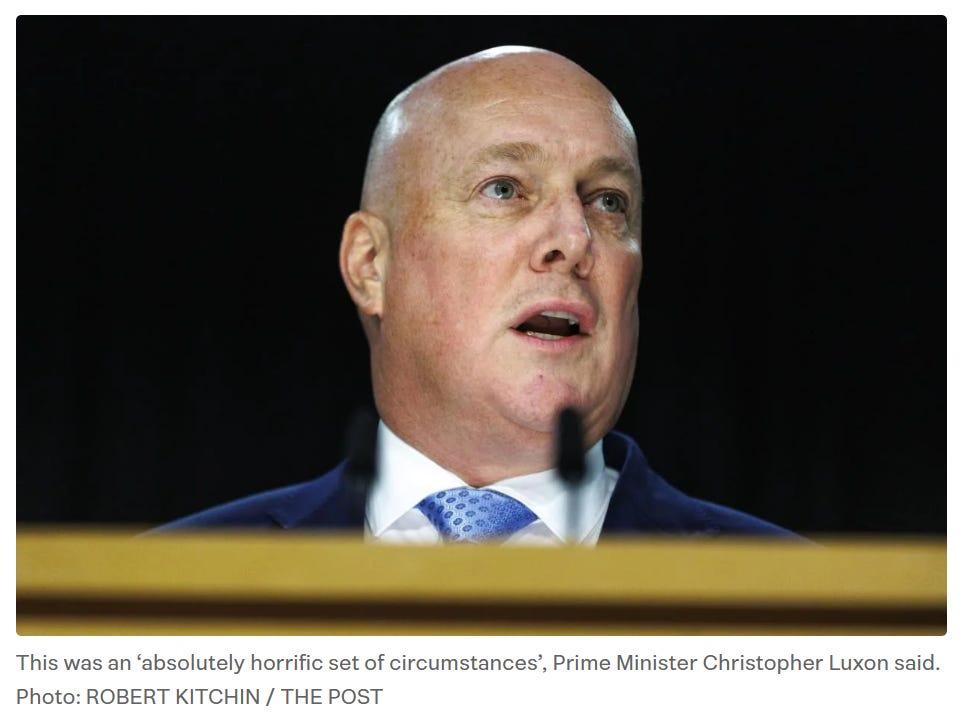
Restraining intellectually disabled adults and injecting them with unnecessary anti-psychotics is a poor substitute for the types of therapies and supports we know makes a difference. Best practice requires ongoing, consistent, adequate funding. It requires safe staffing levels, which means hiring enough qualified people and paying them properly. It means investing into proper facilities. The PM might say it was a horrific set of circumstance, but for too many adults this is just another day.
We have to do better than this. For kids like mine and for all the other kids and teenagers who will be adults soon enough. They all deserve better than being chemically restrained because our society refuses to adequately fund the needed services for a decent life.
Please, this election, make sure you vote for kids like mine.
Thank you, Bex, for a powerful article. Your empathy shines through, and I can understand why it took so long to write. This is the kind of nightmare no parent should ever have to face, whether their child has a disability or not.
Nor should chemical restraint be treated as the first or routine response to the distress or behaviour of any adult, whatever their age or circumstances.
I cannot help thinking this is not simply the product of the current Coalition Government’s nearly three years in office, but the cumulative result of decades of under-resourcing across a range of interconnected systems. It also reflects policies developed in silos, without enough recognition of their upstream and downstream effects on people, families and communities.
Waiting for the foreseeable to happen, particularly when warnings have already been raised, as your article shows, is not an acceptable way to govern. Nor should politicians and government officials act surprised when the consequences emerge, before shifting responsibility or blame elsewhere.
Unless we see a fundamental shift away from the neoliberal policy settings of the past 30 plus years, including major tax reforms that reduce inequity and provide governments with the revenue needed to invest properly in essential public services, I fear that no amount of political concern or apology, welcome though they are, will be enough to prevent this kind of abuse from happening again.
That, to me, is the real issue. No single political party appears to have all the answers. We need to make decisions that consider not only the needs of people today, but also the wellbeing of all our children and future generations, while ensuring we care properly for people in our communities right now.
While it is not a complete solution, I find Ganesh Ahirao’s proposed amendment to the Public Finance Act compelling. Requiring governments to apply a future generations lens to fiscal and monetary policy could help encourage the longer term thinking that is too often missing from political decision making.
Insightfully powerful Dr Bex. Paul is right, we need a political system that prioritises people over profits. Where do we get one of those? Rhetorical.