
In my last post I shared how the systems failures across police, ED, and mental health led to an 11-year-old being misidentified and then chemically restrained. I linked this to ongoing poor practice in mental health, where intellectually disabled and autistic persons end up injected with anti-psychotics as a cheap and easy way to keep them calm and quiet.
This week, the Minister for Mental Health, Matt Doocey, announced his mental health and wellbeing strategy. He touts this as a “long-awaited plan to improve mental health and addiction outcomes, with a focus on launching AI navigation to help access and scale integrated services across mental health, housing and employment.”
When the document first went out for consultation earlier this year, the draft strategy did not reference either the Health of Disabled People Strategy or the Mahi Aroha Carers Strategy Action Plan, despite both disabled people and family carers being at risk populations who experience increasing amounts of mental distress. As you might expect, I did send a rather thorough submission explaining this omission and why it matters - and I was pleased to see that the final Mental Health and Wellbeing Strategy has taken this feedback on board and now includes, references, and specifically discusses disability.
Why does it matter?
Disability-related complexity frequently requires clinicians who understand the intersection of disability and mental health - this is a specialist skill set that goes beyond generalised care. Diagnostic overshadowing (which is where mental health needs are attributed to disability rather than assessed properly) is a real and ongoing risk if disability is not adequately and appropriately addressed. This makes it highly important to include disabled people and to ensure that this population group has dedicated actions.
Essentially, disability is a cross-cutting determinant that shapes experiences and life outcomes. Policies and plans make choices about which populations count and which are priorities worth naming and measuring. Our default system is geared towards the fully able, towards European/Pākehā cultural norms, and to adults. Population groups outside of this tend to experience worse mental health outcomes, as the system (e.g., administrative systems, training of health professionals, and how we deliver services) is not designed to consider other life worlds, experiences, or needs. This is why specific population groups end up with worse outcomes - and why there is mention of specific groups in plans and targets. When disabled voices are absent and when disability isn’t mentioned, listed, or named, this makes it much harder to argue for the needed resources, to improve practices on-the-ground, or to ensure an adequately trained health workforce. In short, the system ends up reproducing the same (poor) results.
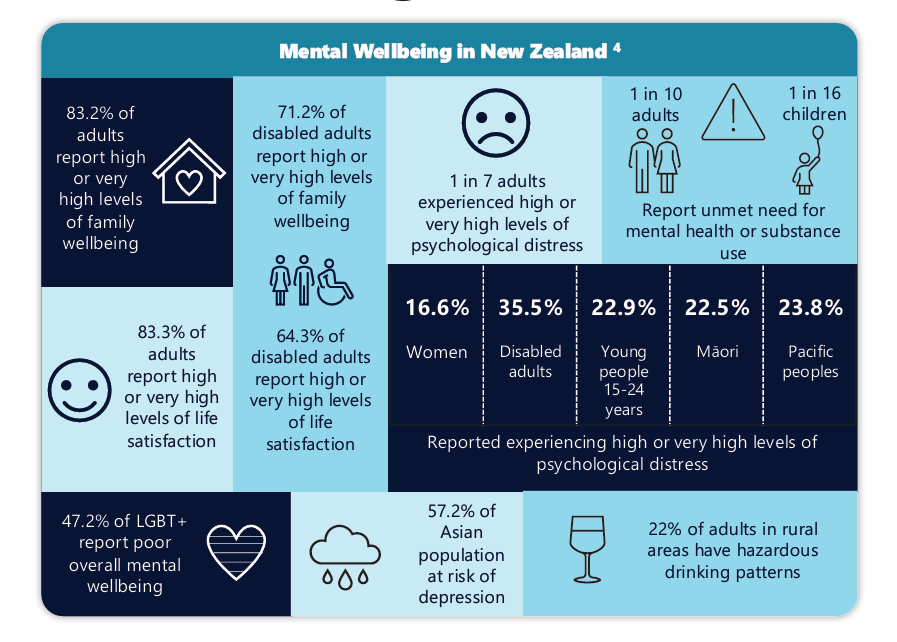
Data from the New Zealand Health Survey1 tells us that disability is an underserved group who experience higher levels of mental distress:
Disabled adults are 4.6 times more likely to experience psychological distress as non-disabled adults, after adjusting for age and gender.
Disabled adults report high or very high psychological distress, compared with non-disabled adults.
Young disabled people (15–24) experience high or very high psychological distress, compared with their non-disabled peers. This occurs alongside higher rates of unmet need for professional help (16% vs 9%).
Given this, one might genuinely expect that disability is specifically referenced in mental health plans, roadmaps, targets, and strategies, right? Right? Sadly, the initial-now-rectified omission in the mental health strategy is not a one-off. Read on below as I wander through a range of Mental Health documents.
First though, a quick digression. The Carers NZ State of Caring Survey documents high rates of anxiety, depression, financial strain, and social isolation. Yet, across mental health strategies, pathways, and roadmaps, family/carers/whānau are predominantly solely positioned as providers of support to someone in need. There is extremely limited consideration of whānau as people in their own right, or as individuals with their own mental health and wellbeing needs. This framing exists across mental health, and makes the assumption that whānau have unlimited capacity to absorb gaps in care, meet the gap in service provision, and have endless resources to provide support. Not only is this assumption empirically unsupported, it is ethically problematic to load families up with providing mental health care without also adequately resourcing them. Family carers are under enormous strain due to inadequate support. Ministers and ministries alike cannot keep shifting needed clinical care onto unsupported family members.

The Roadmap for Mental Health, Addiction, and Wellbeing
Te Hiringa Mahara Mental Health and Wellbeing Commission recently released their Roadmap for mental health, addiction, and wellbeing. Building on the 2018 He Ara Oranga inquiry and 5 subsequent years of monitoring and advocacy, it sets out the following connected priorities:
supporting young people
improving early and equitable access
responding effectively in crisis
centring people with lived experience and their whānau.
There are explicit commitments to Te Tiriti o Waitangi, Kaupapa Māori and Pacific services. Disability is entirely absent. Le sigh.
Senior health professionals in the intellectual disability sector were so appalled by this omission they took the extraordinary step of writing an editorial article for the New Zealand Medical Journal. In three short paragraphs they concisely outline why this is an issue:
People with intellectual disability experience some of the poorest health outcomes in Aotearoa New Zealand. Compared with the general population, they have substantially reduced life expectancy, higher rates of potentially avoidable hospitalisation and premature mortality and persistent barriers to timely, appropriate healthcare.2 These inequities are compounded for Māori with intellectual disability—and, on more limited evidence, for Pacific peoples—whose experiences sit at the intersection of multiple forms of disadvantage.2,3
Mental disorders are also more common in this population than in the general population. International studies estimate prevalence rates for psychiatric disorder between 30% and 50%, depending on case definition.4 Yet mental illness frequently goes unrecognised and untreated, or is attributed to the intellectual disability itself (so-called diagnostic overshadowing).5 Communication differences, atypical symptom presentation, diagnostic uncertainty and limited exposure to intellectual disability in professional training all contribute to delayed diagnosis and treatment.5,6 Most mental health clinicians encounter people with intellectual disability in routine practice, yet many report limited confidence in assessment, formulation and treatment planning—particularly where there is severe impairment, co-occurring autism, trauma or significant behavioural distress.6
Access to evidence-based intervention is correspondingly uneven. People with intellectual disability are less likely to receive adapted psychological therapies, comprehensive multidisciplinary assessment or timely specialist advice as their mental health deteriorates. Behavioural distress is instead too often treated as a management problem, with psychotropic medicines prescribed for prolonged periods in the absence of a clear psychiatric diagnosis.7,8 Families and disability providers describe struggling to obtain help before a crisis. For those with highly complex needs, these barriers culminate in repeated crises, restrictive interventions, prolonged admissions often in locations very far from home and whānau, placement instability and involvement with compulsory care and forensic services.8 Such outcomes are not inevitable consequences of disability; they are the visible end of an invisibility that begins much earlier—in the policies that set priorities, the data that track performance, the arrangements that assign responsibility and the workforce that holds expertise.
Barron DRA, Duff M, Kidd AMJ, et al. Equity requires visibility: intellectual disability and Aotearoa New Zealand’s mental health roadmap. NZMedJ. 2026 Jul 31;139(1639):10-14. doi: 10.26635/6965.7629.
You can read the full article here: Equity requires visibility: intellectual disability and Aotearoa New Zealand’s mental health roadmap. The NZMJ is free to subscribe to, and subscribing gets you free online access to all their published articles.
I don’t have much more to add - other then my own disappointment that such an important priority group is entirely absent from consideration.
Health NZ’s Mental Health and Addiction Targets Implementation Plan
The Achieving the Mental Health and Addiction Targets High Level Implementation Plans July 2024 – June 2027 document sets out the Minister of Mental Health’s targets for services and provides a high level implementation plan. Its stated purpose is to lift mental health and addiction system performance for “many New Zealanders.”
Disabled people, a population with among the highest documented rates of psychological distress in Aotearoa, are absent from this plan. A full-text search of the 25-page implementation plan for the terms “disability,” “disabled,” “impairment,” and “accessib*” returns zero results (yes, I did a CTRL+F, just to double check I hadn’t missed anything in my read through!). Disability is not named in the five targets, or in any of the baseline measures, or in any of the eighteen named actions, and is not in the four named specific demographic or service-stream categories the plan uses to disaggregate performance (these are age, ethnicity, life-course stage, and occupational group).
The Implementation Plan is not indifferent to equity as a concept - it disaggregates several targets by demographic and service category (this is a good thing!). But. Disability remains consistently excluded. This exclusion shows up in the following ways in across various measures - here are 5 key ones:
No disability baseline. Every target carries a baseline figure, and this is disaggregated by age or service stream where relevant. There is no disability-status baseline anywhere in the document, and no commitment to establish one.
No disability lens on the ED target. The ED target’s stated aim is to ensure MH&A presentations do not experience “disproportionately longer stays than those presenting with physical health needs.” A comparator population is explicitly named. Yet, disabled people, who face well-documented barriers in emergency department environments, are not identified as a population whose stay-time data might warrant separate tracking.
No disability-responsive training commitment. The workforce target expands its occupational-group coverage over time, adding in associate psychologists, addiction workforce, peer support workers, nurse practitioners (again, this is a good thing!). However, there is no commitment to disability-responsive or accessible-practice training, and no commitment to even naming ableism in health or acknowledging this as an issue.
Disability is absent from prevention and early intervention. This target is potentially the easiest home for a disability lens. It names the life-course categories (maternal, infant, child and youth services). Family carers of disabled children carry elevated distress risk across these life-courses. There is already an acknowledged need for early intervention and support. It is not too far a jump to link this in.
A weird catch-all category. Action 4 under the ED target references “strategic re-design of services for people with high and complex mental health needs”. This is the closest that the Implementation Plan comes to language that might actually include disabled people. Unfortunately the term is undefined, carries no CRPD framing, and is not connected to any disability data source. Argh.
In short, the Implementation Plan sets itself up to fail, as disability carries a larger documented distress differential than most categories - yet is not tracked, included, or addressed in any meaningful way.
There are some other issues with the plan - while wait times to access public mental health services will be tracked and reported on, other measures - number of declined referrals, staff vacancies in mental health, private referrals - will not be. This makes it hard to understand the full picture (and easier for the Minister to blame health professionals for not being ‘efficient’ enough). Labour spokesperson for mental health, Ingrid Leary, has been asking some very good questions about why these measures are not included. I digress.
A few short suggestions from me
Just off the top of my head, and if I’d seen the document ahead of time to provide input, this is what I would have recommended. Others may disagree or have other ideas! But, I would add/include the following:
Add disability status as a standard disaggregation category across all five targets, using existing NZHS/Washington Group Short Set infrastructure, which makes it consistent with how age and ethnicity are already treated.
Establish a disability-status baseline for each target in the same way baselines are being established for Access and Choice services, rather than treating disability as a potential future or optional addition.
Explicitly include disabled people, and family/whānau carers of disabled children, within the prevention and early intervention life-course targets.
Ground any future revision in CRPD Article 25 (health) and Article 26 (habilitation and rehabilitation). This would ensure consistency with existing obligations and avoid relying on an undefined “high and complex needs” category.
Require disability-responsive practice as a named element of workforce training expansion, alongside the cultural-responsiveness commitments already built into Kaupapa Māori and Pacific service streams.
Mental Health in the workforce guide
Lastly, while rummaging about the internet for documents on mental health and disability, I came across this Mental Health Guide for New Zealand Leaders. It acknowledges the Ministry of Health, the Mental Health Foundation of New Zealand and the Health Promotion Agency for their advice, and is produced by the Government Health and Safety Lead.
It’s a great resource with plenty of useful, helpful, practical information. However. Disability, caring work, and neurodivergence are all entirely absent - with one exception:
Chronic stress is associated with a wide range of physical symptoms, such as skin complaints and general aches and pains. Pain related to injuries can greatly undermine your sense of wellbeing (e.g. chronic back pain is associated with general disability, emotional distress and depression)..
Yes, I did another CRTL+F (it’s a very long document!). Interestingly, the document assumes a monocultural lens. It is very much organised around the norms and values of the dominant cultural group in NZ (European/Pākehā). There’s a sense of studiously avoiding anything one might consider ‘woke’ such as cultural safety, racism, ableism, or even sexism. This is despite there being strong evidence that experiencing any or all of these at work has a significant detrimental effect on both mental health and productivity.
The closest the document gets to acknowledging these issues as having an impact on mental health in the workforce is this small paragraph:
THE ROLE OF CULTURE AND COMMUNITY
Organisations comprise a culturally diverse workforce. Family and community provide an especially important role in some cultures, as do spiritual leaders. It is important that cultural needs are recognised, and culturally responsive initiatives and programmes that restore and strengthen whānau and communities are considered.
This flattening out of who we are like this is deserving of a separate post (this one is long enough as it is!). But it is an interesting snapshot on how documents, in a generic attempt to be for everyone, end up flattening out the specific needs and requirements of underserved groups and fail to address what is actually needed.
Concluding remarks
I am heartened that the Mental Health and Wellbeing Strategy now includes specific reference to disability. It’s encouraging to have been listened to and to see the linkages between this document and existing plans such as the Carers Strategy. I am ever hopeful that will filter through into other areas of mental health. Still, though, it is frustratingly slow work. Undertaking this exercise of reading these documents has made it visible to me just how invisible disabled populations are in government.
It also begs the question(s), How do we improve this? How do we ensure that non-speaking, autistic 11-year-olds (or even 20-year-olds) aren’t routinely pumped full of anti-psychotic drugs by mental health staff in institutions like Henry Bennett? How can we improve mental health if documents like strategies and targets and plans don’t even mention disability or reference the Ministry of Health’s own data?
I don’t have any answers, other than, we keep raising the issue, we keep talking, we keep supporting each other, we keep making submissions on the endless consultation rounds, and we keep on being noisy.
Data sources:
Ministry of Health NZ (2021). Psychological distress by disability status. https://www.health.govt.nz/statistics-research/surveys/new-zealand-health-survey/publications/202021-survey-publications/snapshots-from-the-202021-survey/psychological-distress-by-disability-status
Ministry of Health NZ (2023). Annual Update of Key Results 2022/23: New Zealand Health Survey. https://www.health.govt.nz/publications/annual-update-of-key-results-202223-new-zealand-health-survey
Whaikaha – Ministry of Disabled People (2025). Disabled people experiencing poorer health and wellbeing than non-disabled people. https://www.whaikaha.govt.nz/news/news/disabled-people-experiencing-poorer-health-and-wellbeing-than-non-disabled-people
Mental Health and Wellbeing Commission — young disabled people data, via Whaikaha. https://www.whaikaha.govt.nz/news/news/mental-health-and-wellbeing-outcomes-for-young-disabled-people-results-from-mental-health-and-wellbeing-commission-research
Bex - as you clearly highlight here, the current coalition government appears wilfully blind, lacking in political will and siloed in their thinking. To my mind, this increases the risk of fragmentation, and of people falling through the cracks because they simply do not feature in government strategies, targets and plans.
I get that Ministers Louise Upston (Ministry of Social Development and Disability Issues), Simeon Brown (Health), and Matt Doocey (Mental Health) will be busy people. They receive significant money for the responsibility of being a MP and Cabinet Minister. Like all people working to do a job, they should earn the money they receive. I’m waiting for them to lift their game but continue to be mightily disappointed. In Louise Upston’s case, all I see her doing is parroting repetitive talking points.
If I want to listen to a parrot, there are many mobs of them here in Australia where my partner and I live and work because NZ lost her due to the actions of the newly-elected National-led coalition government.
Cockatoos, magpies, tūīs…birds and creatures of all kinds communicate with one another! “Which direction will we fly next?!?”
Have these government ministers actually talked with one another about policy, strategies, targets and plans? Effective dialogue can bring about solutions that prove governments can in fact do their very best to govern for all citizens.
Does it matter if we do not make the time and effort to engage in dialogue? YES! It matters hugely. The lack of recognition and diminishing of culture (of care-giving, disability, wellbeing, Māori, Pacifica…) by the current coalition government continues to disturb me.
Trapped by their caged norms and relentless retelling of the ‘austerity’ story and insistence upon reducing government spending relative to GDP (having already spent hugely on tax cuts for a few), they have painted themselves into a corner. Pride, arrogance, incompetence combined with an incessant itch to manage (with a correspondingly disturbing unwillingness to listen), and an insistence that they must win the contest of ideas (even with a total lack of effective leadership) are features of their continued bumbling and missteps.
As a qualified psychologist and first ever Minister for Mental Health in Aotearoa, I wonder how Matt Doocey can reconcile being part of a government that removed measures of wellbeing?!? I’d like to look him in the eye and engage in a face-to face conversation about that single topic for at least an hour! Of course he’d be reluctant and resistant to doing so.
As a NZ citizen, taxpayer and active participant in our democracy, I expect better from our elected representatives.
But first, they would need to release themselves from their self-imposed prison. And voters, tax payers, citizens cannot do that work for them.
If the government chooses not to govern for all citizens, do they deserve to be in government at all?
All time levels of poor mental illness following the Fauci show ( covid19) with govt's social isolation and "fear of others" memes for 2 years. Followed by media stress that took its toll and now those that contributed and caused the problems want to develop strategies to make govt look better.
I dont think labels help people they can hold a temporary condition or an unhealed truama in place.
The govt moves on medical system's globalization unhelpful technology like ai even when ai with its hallucinations and corporate programming is not a good tool for mental health service users.The govt dont even understand the cause of addiction it sounds like they are planning on doing a crackdown on the mentally unwell. Call me a realist or skeptic ai will conclude they are not unwell.
I know non disabled people depressed for decades in the govts mental health system treated seeing psychologists psychiatrists drugs prescribed etc. ineffective .
Ive found the words spoken by govt (PR) are empty.
Look at how the govt meets its arbitrary targets in medicine it makes up despicable things like not diagnosing,delaying diagnoses and bed blocking. Not Ok, its pathological thinking .