

The ACT Party has been busy spraying their anti-Māori racism everywhere, again. Yesterday, they took aim at the public service and at public health, revealing their collective lack of understanding of how actual workplaces exist in the real world. Their target was karakia in the workplace - a time-honoured, evidence-based practice that builds teams, reduces burnout, and improves performance. It isn’t the first time they’ve taken aim at karakia - back in 2024 they also took a swipe at it. Unsuccessful then, they’re having another go now. You’d think a party wanting to promote efficiency and boost productivity would be all for a inexpensive practice that does this, wouldn’t you? Unfortunately, the need to be as anti-Māori and as anti-Indigenous as possible in order to win votes trumps actual evidence.
Speaking of evidence, lets have a very quick romp through some, shall we? First though, a quick description:
Karakia in practice
One of the challenges in translation generally is that, while a word may translate into another language, that doesn’t necessarily capture the meaning, or essence, of that word or practice. The word karakia is a bit like that - it is typically translated as ‘prayer’ with many Pākehā viewing it as a religious practice akin to attending church. (Aside - it can be worth considering our nations history and why a christianised practice in the context of settler-colonialism survived across generations. I digress). While a karakia (singular) can be a Christian prayer, karakia (plural) are so much more. It is quite reductive to reduce a meditation, a reflective pause, a practice of care, a gratitude down to superficial, atheistic understandings of prayer.
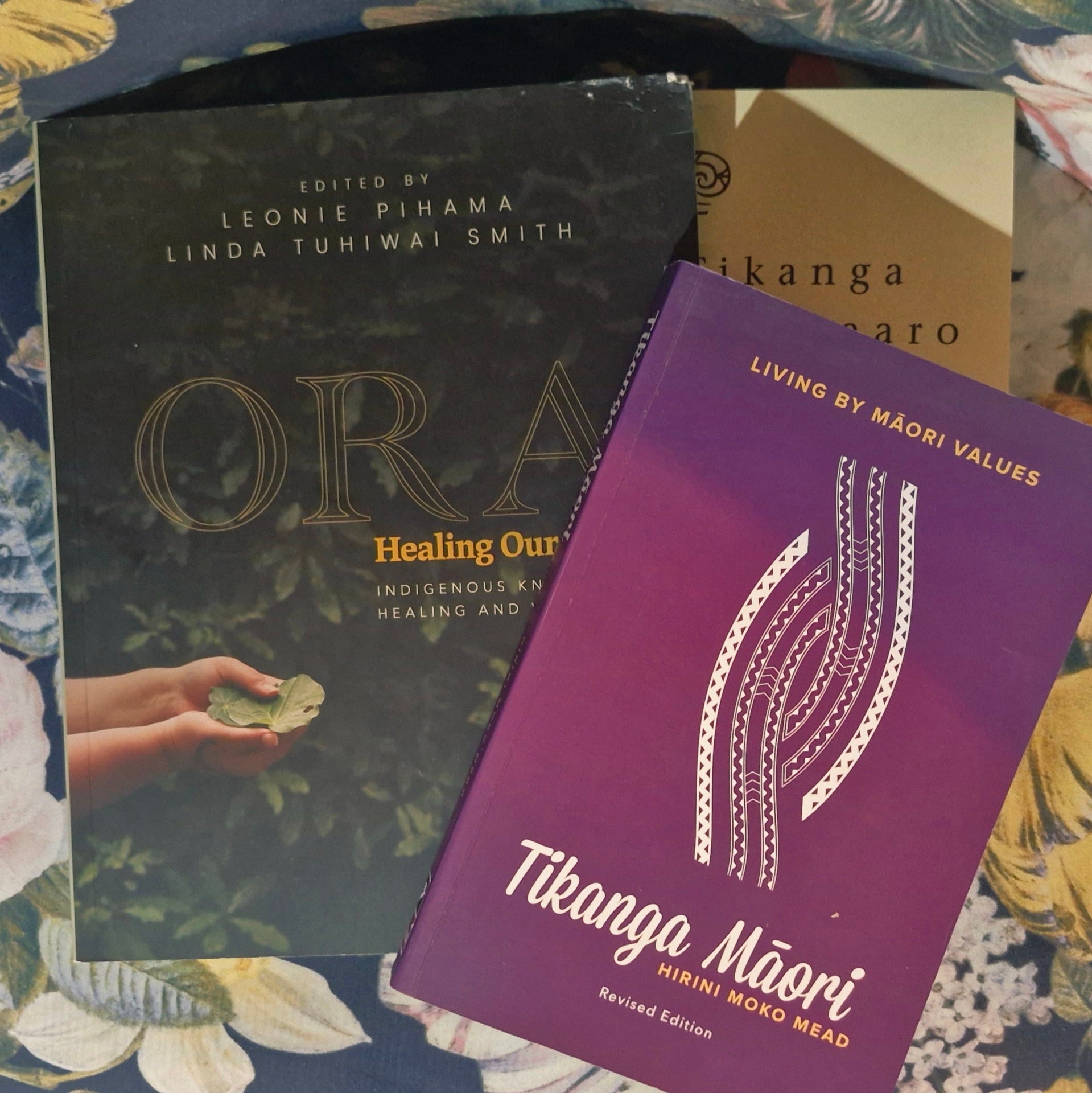
There are many excellent Māori scholars who have written about karakia. My preference is for writings who consider the whole, rather than parsing practices into their individual parts. It is a peculiarly Western thing, after all, to reduce ideas and practices down into their individual respective parts, to define the thing exactly, to extract its essence and meaning. It is a shift in one’s thinking, to move on from a tick-box exercise on an agenda, into considering how karakia moves and flows with the day. The following description and understanding of karakia from ORA Healing Ourselves resonates with me in particular:
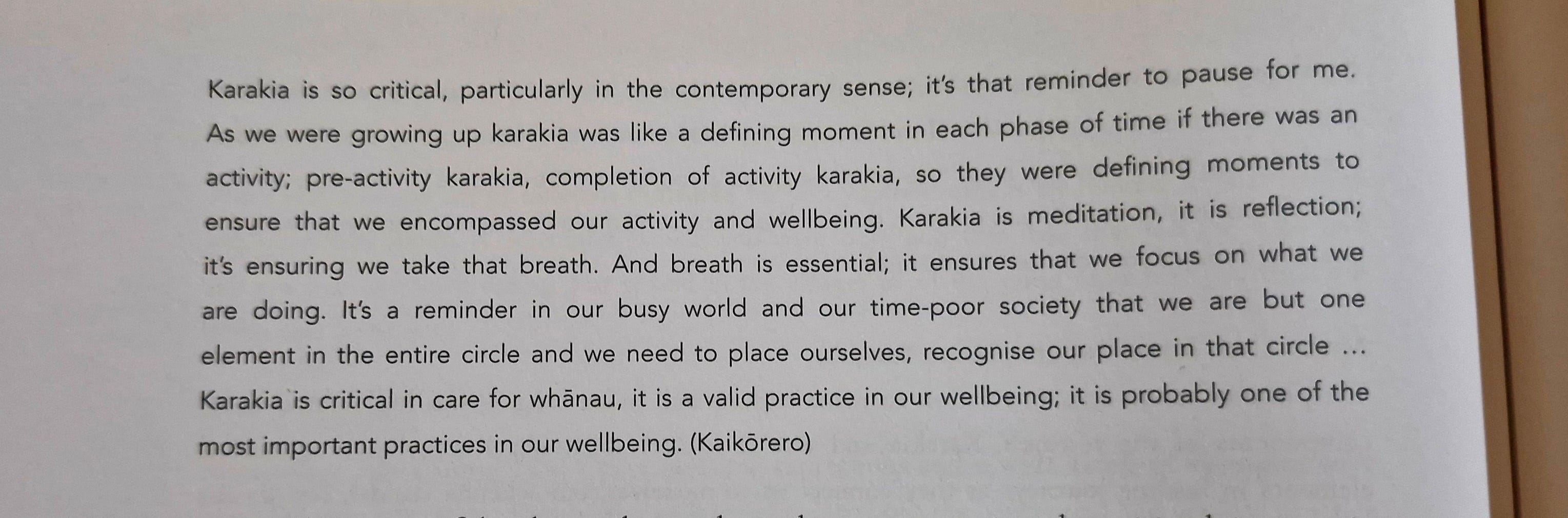
Karakia is so critical, particularly in the contemporary sense; it’s that reminder to pause for me. As we were growing up karakia was like a defining moment in each phase of time if there was an activity; pre-activity karakia, completion of activity karakia, so they were defining moments to ensure that we encompassed our activity and wellbeing. Karakia is meditation, it is reflection; it’s ensuring we take that breath. And breath is essential; it ensures that we focus on what we are doing. It’s a reminder in our busy world and our time-poor society that we are but one element in the entire circle and we need to place ourselves, recognise our place in that circle ... Karakia is critical in care for whanau, it is a valid practice in our wellbeing; it is probably one of the most important practices in our wellbeing. (Kaikōrero) - p.42, Pihama & Tuhiwai Smith, 2023.
Starting the work day with karakia is a way to gather the team, a pause for reflection and connection before the busyness of the work day. It’s a way to remind ourselves that we are people, that we work with people, and that we have value. In workplaces that are particularly stressful, such as in health and hospitals, its a valuable way to start the shift, build the team, and remind staff they matter as people. It’s a pause and a shared breath.
Taking time at the start of meeting for karakia is a way to collective gather the group together. People often arrive at meetings with other things on their mind, rushed and full of busyness. Taking time for karakia is a way to pause, take a breath, and allow time to focus on the intent of the meeting. If a topic or agenda is particularly heavy or hard, karakia can help open up the space - and help to close it again, leaving the discussion behind as people leave for the next part of their day. It’s a way to acknowledge our emotions, let them go, and move forward.
The evidence base
There is an emerging evidence base for the value of karakia in the workplace. I’ve created a short annotated list at the end of this post, but key publications and their findings are as follows:
New Zealand Work Research Institute study
This 2020 study by Haar, Roche & Brougham examined seven organisations they identified that were using ‘Māori High Performance Mahi Tautoko’. They included practices of karakia, waiata, pōwhiri, whanaungatanga and whānau inclusion which were layered onto standard high-performance work systems. Across 477 Māori employees, those organisations that offered these culturally-tailored practices had better job satisfaction, career satisfaction, work engagement, cultural wellbeing, work-life balance and lower emotional exhaustion than organisations without them.
Morning karakia and waiata as culturally responsive pedagogy
In this 2023 paper, Motu et al., researched the voluntary morning karakia and waiata at the University of Canterbury. Of 65 participants in the study, 59 said it assisted with maintaining their physical, emotional, mental and spiritual wellbeing. 58 out of the 65 participants noted that it strengthened connection to colleagues and community. Overall, the impact of karakia was described as flattening hierarchy and building relationships across both staff and students.
MBIE: Inclusive Workplaces for Kaimahi Māori
This research found that te reo and tikanga use (including karakia) in the workplace, as part of the ordinary work day, strengthens a sense of inclusion and belonging for employees. This is linked to improved retention and productivity. This report went further, noting the ‘cultural double shift’, whereby Māori staff are expected to undertake extra cultural guidance and advisory duties on top of their normal role, and that this can undercut the wellbeing and productivity gains if not resourced properly.
International research
The above research within a New Zealand context sits within a broader context of international literature on the value of workplace rituals more generally. This research is not karakia-specific, but it provides wider context - workplace rituals are good for reducing anxiety, improving performance, and creating healthier workplaces. Very briefly, Vohs, Wang, Gino and Norton's research (Rituals Enhance Consumption, Psychological Science, 2013) found that performing a ritual before an activity increases engagement and perceived value. Yim, Klotz, Foulk and Schilpzand published in Harvard Business Review (2025) on how larger organisational rituals affect engagement. Hobson, Schroeder, Risen, Xygalatas and Inzlicht’s Psychology of Rituals review lays out a broader evidence base for why shared ritual builds group cohesion and a sense of control.
Alongside the above, there is a fairly extensive evidence base for meditations, affirmations, breathwork, and the like in terms of mental and physical health.
The issue isn’t that the evidence doesn’t exist - it’s that ACT knows that anti-Māori racism wins votes. Their claims in social media posts and in press releases are not supported by the evidence. Spurious, reductive statements adding up minutes in karakia while deliberately failing to apply the same rationale to introductions, agenda reading, handshakes, or any of the other small rituals that open meetings is not being ‘equal’ - it is intentionally singling out inclusive and supportive practices to win votes. Using wording like ‘social engineering project’ is a strange way to describe acknowledging peoples humanity - but it shows a clear intent to import overseas cultural wars for votes.
Where to from here?
Karakia is a beloved, time-honoured, and useful practice. Many of us use it during the work day as it really does make a difference. So I say, keep using karakia as ordinary, everyday practice in the workplace. Put it on your meeting agenda, start your workday with it, learn a bunch to say at any time. Tell others how valuable you find it, that you appreciate starting the day with it, be overt in your support for the practice. Tuhi Stationary and Pūkenga Psychology both have beautiful card sets you can order - order some, hand them out, share them around. If you need evidence to share with others, draw on the links below.
Remember, ACT is deliberately fomenting anti-Māori sentiment for votes, so make it a habit to ask everyone if they’re enrolled to vote and have a plan to vote.
If you are a free Subscriber - thank you for following my Substack! It is thanks to my paid subscribers that I can keep all my posts free for anyone to read.
Annotated list of published research
New Zealand based
Brougham, D., Haar, J., & Roche, M. (2014). Work-family enrichment, collectivism, and workplace cultural outcomes: A study of New Zealand Māori. New Zealand Journal of Employment Relations, 40(1), 19–34. https://researchcommons.waikato.ac.nz/server/api/core/bitstreams/b1e22885-c8e1-4adb-86f3-36ac8ec20003/content - Surveyed 172 Māori employees across 14 organisations. Found work-family/family-work enrichment predicted workplace cultural wellbeing and cultural satisfaction; collectivism moderated the relationship. Note: does not examine specific tikanga practices like karakia directly, and the authors explicitly flag a lack of empirical research on tikanga Māori in NZ workplaces at time of writing — useful mainly as a marker of the evidence gap that later studies (above) begin to fill.
Diversity Works New Zealand / Workplace Inclusion. (2021). Manatū Mō Te Taiao – Ministry for the Environment. https://workplaceinclusion.org.nz/2021-case-manat%C5%AB-m%C5%8D-te-taiao-ministry-for-the-environment - Practitioner case study. All staff hui open with karakia and the ministry’s waiata; karakia posters displayed in meeting rooms. Reports strengthened whanaungatanga, sense of belonging, and engagement across a geographically dispersed workforce, alongside a Te Ao Māori strategy built on Mason Durie’s health model.
Haar, J., Roche, M., & Brougham, D. (2020). A kaupapa Māori approach to human resource management practices in Aotearoa workplaces. Ngā Pae o te Māramatanga / New Zealand Work Research Institute, Auckland University of Technology. https://workresearch.aut.ac.nz/__data/assets/pdf_file/0004/450463/Nga-Pae-HPWS-Maori-Finalupdate.pdf - Seven case-study organisations using “Māori High Performance Mahi Tautoko” (karakia, waiata, pōwhiri, whanaungatanga) alongside standard HR practices. Surveyed 477 Māori employees; culturally-tailored practices were associated with higher job and career satisfaction, work engagement, cultural wellbeing, better work-life balance, and lower emotional exhaustion.
Ministry of Business, Innovation and Employment. (2024). Inclusive workplaces for kaimahi Māori: The key findings. Retrieved 17 August 2026, from https://www.mbie.govt.nz/business-and-employment/employment-and-skills/employment/inclusive-workplaces-for-kaimahi-maori/the-key-findings - Government research summary: te reo and tikanga use (incl. karakia) strengthens feelings of inclusion and belonging; inclusion linked to retention and productivity. Also identifies the aronga takirua (cultural double-shift) risk: unpaid cultural-guide duties that can erode wellbeing gains if not resourced.
Motu, K., Watson, P., Rātima, M., Karaka-Clarke, T., & Stevens, S. (2023). Tūrou Hawaiki: Morning karakia and waiata as culturally responsive pedagogy. The Australian Journal of Indigenous Education, 52(1). https://ajie.atsis.uq.edu.au/ajie/article/view/326 - Survey (n=65) and interviews (n=9) on voluntary morning karakia/waiata at the University of Canterbury School of Teacher Education. 59/65 reported it helped maintain physical, emotional, mental, and spiritual wellbeing; 58/65 reported strengthened connection to colleagues/community; 47/65 reported increased confidence in Māori cultural participation. Practice was described as flattening hierarchy and building more personal staff/student relationships.
Workplace Rituals
Hobson, N. M., Schroeder, J., Risen, J. L., Xygalatas, D., & Inzlicht, M. (2018). The psychology of rituals: An integrative review and process-based framework. Personality and Social Psychology Review, 22(3), 260–284. https://doi.org/10.1177/1088868317734944 - Integrative review of the ritual literature (not workplace-specific) proposing a framework for how ritual structure, rigidity, and repetition drive downstream psychological effects including emotion regulation, group cohesion, and performance.
Vohs, K. D., Wang, Y., Gino, F., & Norton, M. I. (2013). Rituals enhance consumption. Psychological Science, 24(9), 1714–1721. https://doi.org/10.1177/0956797613478949 - Experimental studies showing that performing a ritual before an activity (eating, etc.) increases enjoyment, engagement, and perceived value of the activity, via increased involvement.
Yim, J., Foulk, T. A., Klotz, A. C., & Schilpzand, P. (2025). Is everyone having a good time? The effects of complex organizational rituals on employee engagement and behavior. Journal of Management. https://doi.org/10.1177/01492063251355251 and Practitioner summary: Yim, J., Klotz, A. C., Foulk, T. A., & Schilpzand, P. (2025, July–August). New research on how to get workplace rituals right. Harvard Business Review. https://hbr.org/2025/07/new-research-on-how-to-get-workplace-rituals-right - Study of complex organisational rituals (retreats, onboarding events, holiday celebrations) and their effects on employee engagement and subsequent behaviour; identifies both engagement benefits and avoidable pitfalls that undercut them.
ACT summary - press releases and links
David Seymour’s public service reset policy announced 16 Aug 202. ACT wants to bar public service employers from ‘initiating or resourcing cultural or spiritual practices as part of the workplace’, with Seymour quoted as saying “nobody should be expected to take part in a prayer, karakia, or other spiritual practice because they work for the Government”, and that “taxpayers should not be required to fund staff time or other resources for employer-initiated spiritual activity either.” ACT MPs wrote additional commentary on their social media pages.
ACTs 2024 press release re: Health NZ/Te Whatu Ora called karakia during work hours “a complete distraction,” a “social engineering project,” and invoked an equivalence to Christian prayer. This present release argued that if staff were encouraged to pray, it’d be seen as inappropriate, so karakia should be seen as inappropriate too.
Sources:
Just about to join our morning Kaikōhau, setting team intentions a practice space for tangata tiriti action, waiata o te rā and a cuppa. Such a good way to set the tone of the day - Nau mai te aroha, nau mai te kaha, nau mai te mahi tahi. Tihei mauri ora!
Beautiful - opposite of 'fast track'