
National sets up means testing for disability support
The new DSS Bill undermines independent living for disabled persons, entrenches unpaid care by family, and creates the legal framework for means-testing — all without consultation.

The Minister for Disability Issues, Louise Upston, has unveiled a new Bill that will give Disability Support Services (DSS) a legal basis. She is spinning this hard as something this is necessary for risk management, that clarifies the contributions of families, and that provides a transparent, consistent framework of support.
As Huhana Hickey articulates so well,
Disabled people in Aotearoa have become fluent in government language and we know that when ministers start talking about sustainability, clarity, fairness, and stability, it is worth paying close attention to what is happening behind those carefully chosen words.
I talked to Emily Writes today about this new Disability Support Services Bill that the coalition government is whipping through Parliament at pace.
It paves the way for income and asset testing for disabled adults and children. It also narrows the ability of families to get support for their disabled children, and narrows support for disabled adults to be able to live full, independent lives.
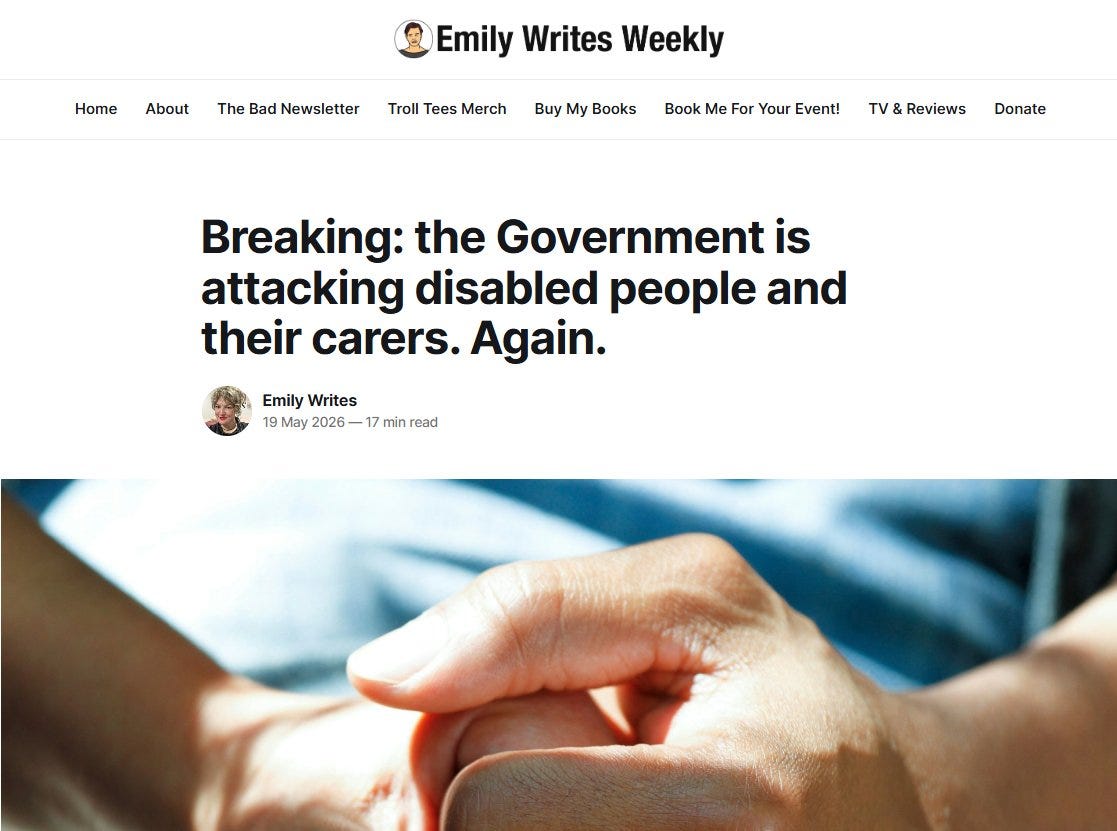
Emily has done a fabulous job of pulling initial responses about the Bill together:
Both the New Zealand Labour Party and the Green Party of Aotearoa New Zealand have stated that they oppose this Bill.
Priyanca Radhakrishnan (Labour MP and Spokesperson for Disability) states “The Government is abdicating from its responsibility to support disabled people and family carers ... This Bill is the death knell for a move towards embedding Enabling Good Lives principles in DSS funding. It moves away from greater independence, more choice and control for disabled people over the supports and services they access.”
Kahurangi Carter (Green MP and Spokesperson for Disability) noted that this was “a political choice. Disabled people and our whānau deserve a leader who ensures we can access our communities and live with dignity”.
Why is everyone reacting to this Bill?
This Bill goes much further than just setting up the legal foundations for Disability Support Services (DSS). My initial read notes the following:
1. We do need a legal foundation for DSS
There is a need for a legislative framework. DSS hasn’t had a legal framework since 2022, when the NZ Public Health and Disability Act was repealed. Labour had something it was working on, but didn’t pass it in time, leaving a vulnerability.
In this regard, yes the Bill is needed, and it does do the following:
Sets a statutory purpose for DSS-funded services (Clause 7)
Enables ministerial programmes as secondary legislation to set policy (Clause 11), and
Preserves existing funding allocations and policies for a 3-year transition period while the details around family carers and disabled people with limited decision making capacity who do not have a PPPR in place are worked through.
Regarding the latter, one important aspect of the Bill is that it retrospectively validates agent arrangements (persons who act on behalf of disabled person but where there is no relevant order in place under the Protection of Personal and Property Rights Act 1988 (PPPR Act)) while it sorts out something more suitable.
There is an admission that “It is not possible to quickly identify all disabled people in the system who may lack decision-making capacity…” which is an interesting admission to ponder, that our state systems cannot easily identify our most vulnerable persons, nor, one assumes, provide the necessary checks and balances to prevent abuse.

2. Employment related issues
A big part of this Bill is setting out that the State is not, and was never meant to be, the employer of family carers. It actively cancels out the complaints and legal action that is in works, including those that have already been lodged. This is predominantly to reduce and contain the fiscal risk to the Crown by family carers seeking fair recompense for their unpaid labour - something the Supreme Court recently upheld in Court, but the government is now overturning: Government to overturn court decision recognising family carers as employees | Stuff
Part 4A of the NZ Public Health and Disability Act 2000 did something similar when it barred family care discrimination claims after the Atkinson case in 2013. That provision was eventually repealed in 2020 without replacement safeguards, which is part of what led to the Humphries & Fleming judgment by the Supreme Court. The Government is now reinstating a broader version of the same bar, without replacement safeguards, and using urgency to avoid proper scrutiny.
In terms of employment-related matters, the Bill does the following:
Extinguishes pending employment claims without compensation. (Remind you of anything? Pay Equity elimination of claims perhaps?)
Creates a “families first” principle (Clause 8). This Clause enshrines unpaid family labour as ordinary and expected practice, with no legal requirement for the State to sustain carers.
Limits wage-related hours and payments. Family carers who are working unfunded hours are deemed to not be working. During the three-year transition period, any hours a family carer provides in excess of their funded allocation are deemed not to be “work” for the purposes of the Minimum Wage Act 1983. Basically, a family carer providing care beyond their funded hours has no legal entitlement to minimum wage for those additional hours
Removes employment-related benefits. The Bill removes MSD’s obligations to ensure family carers take breaks under the Employment Relations Act, receive leave under the Holidays Act, work in safe conditions under the Health and Safety at Work Act, and receive parental leave entitlements. These are presented as administrative burdens being lifted from MSD. From the perspective of a family carer, it is shifting that burden onto families and creating additional unpaid labour.
Essentially, the Bill is loading up families to provide unpaid care, stripping back their employment rights, creating legislation to sanction unpaid family care, and is abdicating the Crown from any legal responsibility to unpaid family carers.
3. Family is made primarily responsible for (unpaid) care
This legislation puts the onus for care onto family - not just parents but spouses, siblings, children, and even grandparents. Clause 8 of the Bill establishes a binding legal principle that families and whānau “have responsibility in the first instance for the well-being of their members” and that eligible persons should, before being provided with DSS, use their own resources and any support available from family, whānau, and community. It also requires that this principle must be taken into account by MSD and all contracted providers in every funding decision.
The Bill places no limit on what families can be expected to provide, or for how long. It does not distinguish between the support a parent provides to a young child and the expectation that the same parent will provide that support into the disabled person’s adulthood, middle age, and beyond. The Bill’s framing assumes that all families are available, capable, healthy, fully functional, and resourced to provide care across the entirety of the disabled persons lifetime.
The UNCRPD is explicit that disabled adults have the right to live independently and to be included in the community, not to remain in a position of dependence on family care as a substitute for publicly funded support. The Bill creates the opposite of this.

4. Introduces the ability to asset and income test
The Bill lays the legislative framework for income and asset testing of disabled people and families. From here, the relevant Minister would just need to announce it via secondary legislation and boom, disabled people are now income tested. It’s a very sneaky way to get this in as it isn’t introducing income testing per se, just setting the legal framework to allow it at a later date.
Clause 11(3) outlines the eligibility criteria for DSS. It states that ministerial programmes may specify explicitly include (f) income-based criteria, and (g) asset-based criteria. These are listed alongside criteria like nature of disability, age, and living arrangements. Essentially, the Bill sets up the legal architecture to means-test disability support. This is new. Historically, DSS has been needs-based, not means-based. Public services such as health, education, and even ACC are not means tested, so this marks a departure from what has been universal support.
It’s also pretty sneaky. It sets up a whole raft of disability-related programmes to be (a) allowed through secondary legislation, and (b) income testing. Secondary legislation means there is no requirement for Parliament to vote on it. The Minister can introduce income or asset testing for any DSS programme by a written notice. It doesn’t need to go through the House, or to Parliament, or to Select Committee.
The aforementioned “families first” principle in Clause 8 amplifies this. Clause 8(b) already requires that before DSS is provided, an eligible person should “use their resources.” This is a little vague but if you combine Clause 8 (use your own resources first) with Clause 11(3)(f)-(g) (DSS programmes can set income and asset thresholds) you have a ready made means-testing framework.
There is also no minimum floor. The Bill sets no minimum level of support that cannot be withdrawn on means-testing grounds, and no requirement that means-testing criteria be reasonable or proportionate. This gives the State power to deny DSS at any level they decide. A disabled person with modest savings or a working partner could be denied support or only allocated a reduction in support. A family that worked hard to provide a permanent home for their family member could see that asset used to deny the disabled person access to supports and programmes. A disabled person whose spouse earnt over the threshold could see DSS support reduced. Parents encouraging independent living for their disabled young person could see the supports needed for this denied.
The associated documents do not openly flag this change. There is discussion on the need to ensure that expenditure is “managed within appropriated funding”. However, it never explicitly says “we are creating the power to means-test DSS.” Creating the legislation to allow for income and asset testing of disability support is a significant long-term policy shift that this Bill is sneaking through as a technical drafting detail.
Zero consultation.
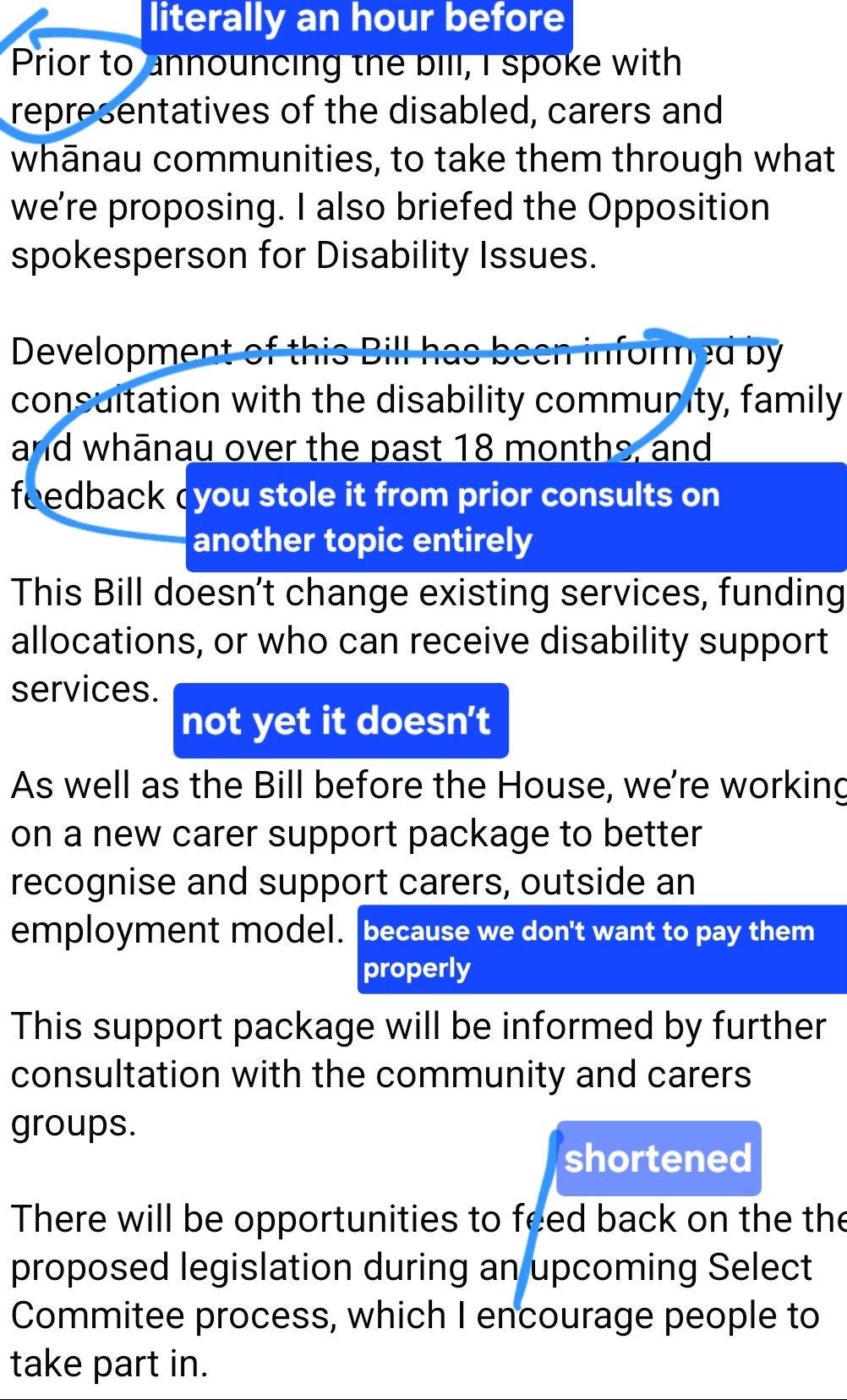
All of this was done without any consultation with disabled people or families. Disabled People’s Organisations and a handful of Parent-led Organisations were summoned to a 30minute briefing right before the Bill was introduced to Parliament and the ministers press release sent out. The documents themselves note that there was no external consultation on the Bill. However, they explicitly state that policy development has considered:
feedback from previous community consultation in 2024.
feedback from previous community consultation in 2025.
feedback from focussed engagement with stakeholders on the purpose of DSS in late 2025.
And that agency consultation was undertaken with:
Oranga Tamariki
Public Service Commission
Treasury
Te Puni Kōkiri
The Ministries of Business, Innovation and Employment (and Accident Compensation policy), Disabled People, Justice, Health (and Health NZ), Education, Ethnic Communities, Foreign Affairs and Trade, Pacific Peoples, Social Development, and Women.
It’s rather undermining of trust, to have the ideas and thoughts shared in previous consultation rounds on other topics, to now be used to justify a whole new legislative framework explicitly designed to reduce risk to the Crown, rather than support disabled people and families.
In short
It’s not just the court case (which won, and is significant) - there are more cases coming down the line, as family carers who have been providing care 24/7 seek compensation for their unpaid labour. The government is seeking to minimise the fiscal risk to themselves. As well as cancelling all the existing claims in progress, this Bill prevents any further employment related claims. It also does something quite underhand, in that it limits what family carers can be paid and sets up the legislative framework to introduce asset and income testing for disability support services.
The Spin
The Minister of Disability Issues, Louise Upston, is spinning it hard - but she conveniently leaves out inconvenient truths; she told a handful of people that she handpicked an hour before sending the Bill to Parliament (and did not even link to the Bill or the documents); the DSS staff used feedback from consultation on another topic entirely and there was no external consultation on this Bill; the Select Committee process is truncated; they don't want to pay family carers properly (the whole focus of this Bill is not paying family carers).
What can we do?
Share this article as far and wide as you can.
Share other articles by disability advocates on this topic. Both Nick Ruane and Huhana Hickey have written good pieces. The more shares, the more attention the topic gets.
Tell the people you know, in your world, how this affects you. Tell them how it affects your friends. Message and text them. Send them a link! But mostly talk to those around you about what is happening.
Enrol to vote! Ask others if they’re enrolled to vote! Make a plan to vote in the upcoming election. Elect a better government than this coalition.
Write an email to your local MP and local candidates. Tell them how this issue affects you and what you think. It doesn’t have to be long, or fancy- the important part is that you tell them.
Speaking of writing, letters to the editor are still a solid thing to do. Local newspapers, national papers, the Listener - whatever magazine you read, write to them about this.
When it comes time to make submissions to Select Committee - make a submission!


At every turn of this COG’s attack we are all complaining of the same issues. As you say - no consultation! Fascisim is its name.
Thank you for this great analysis and balanced analysis Bex.
I trust this makes it into the hands of the media as a DSS Bill 101, as well as the Opposition Spokespeople for Disability Issues.
I will be watching the First reading speeches at Parliament's Thursday introduction with interest. I hope they have tested the Debating Chamber's fire suppression system recently as I'm expecting some incendiary speeches!
I appreciate all the mahi sitting behind this post and your leadership, and those of many amazing others such as Huhana Hickey, Nick Ruane, Blake Forbes, Emily Writes, and others who are providing their own lived experience and expert advocacy on this Bill.
I'll definitely be using your artickein my own submissions, awareness raising and advocacy, and will share widely.
Arohanui.