

Yesterday, the Social Services and Community Select Committee released their report and recommendations regarding the DSS Bill. The Minister for Disability Issues, Louise Upston, had a very carefully prepared press release. It made me angry, so I printed out the large print alternate format and turned it into a blackout poem:
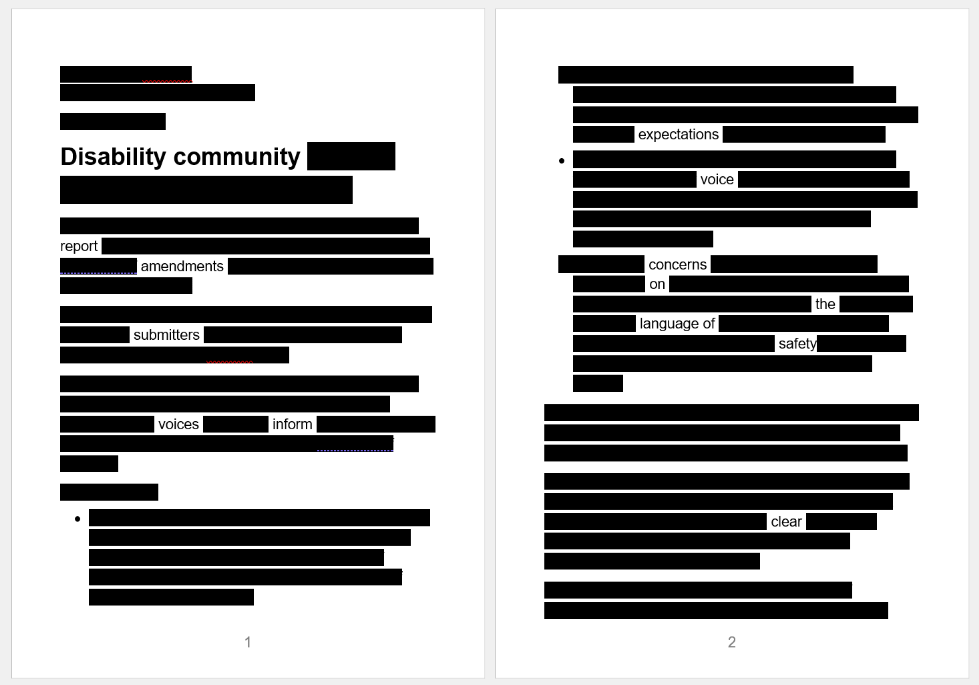
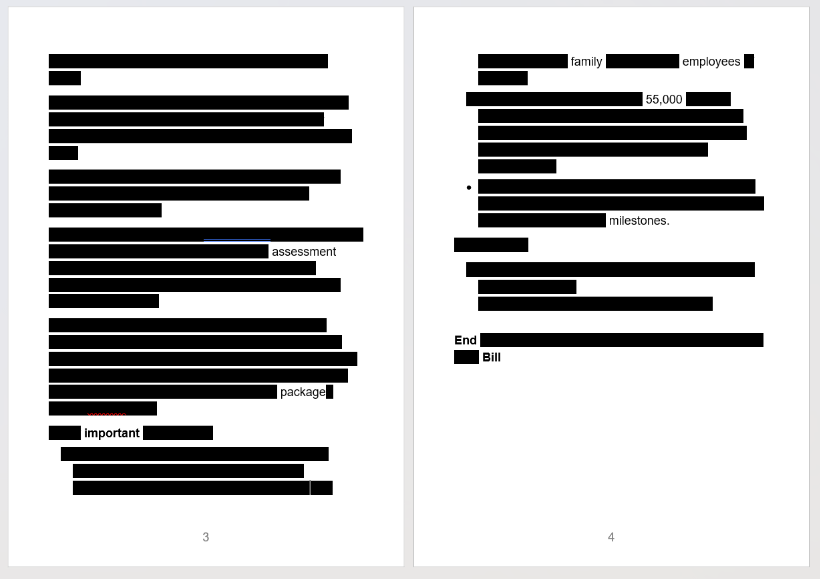
Disability community report amendments
Submitters voices inform expectations
Voice concerns on the language of safety
Clear assessment package
Important family employees
55,000 milestones. End Bill
All that work by thousands of people, for the absolute bare minimum this government can get away with doing. It’s exhausting.
Here is some actual analysis
Huhana Hickey has written an excellent detailed post that summarises the changes, how they reflect (or not) what was asked for, and fact checks the Ministers statements. It is a good read:

My hot take? It’s the bare minimum the Minister could get away with changing before her coalition partners walked away. NZ First were lobbied by multiple members of the disability community, and the scuttlebutt is that NZ First blinked, forcing the Minister to engage with the disability community. How true is such gossip? I guess we’ll never know.
At any rate, while there are some improvements, the DSS Bill still
kicks down at family carers providing 24/7 care for a family member.
expects family members to contribute to care.
expects support services to take both the individual and family’s existing resources into account when determining what support they will provide.
explicitly seeks to constrain the fiscal and litigation risk to the Crown following
the Supreme Court decision in Fleming v Attorney-General
I feel so disheartened. I think of the over 19,000 people who submitted against the DSS Bill - nearly 16,000 via petition and over 3,300 wrote individual submissions. Some of those submissions were from organisations, who together represent thousands more disabled people and families.
I think of all the effort many of us went to, to present in person for our allocated 5 minutes. I think of the attitude we copped from the National MPs sitting on that Committee and how they didn’t want to listen to us. I think of the dismissive attitude of the Minister when she first sent the Bill to Parliament, the odd insistence that disabled people couldn’t possibly know what they were talking about and that all this critique was because we were misinformed and hadn’t read the bill (spoiler - disabled people are extremely savvy when it comes to legislation and disability rights). This attitude only changed when it became clear that the Select Committee would not agree to pass the bill as it was.
It was so much work. It all took time and energy and expense. These resources were taken from our poorest and most marginalised groups in society - many of whose weekly income in the hand is less than Minister Upston’s $1,000/week accommodation allowance - all because the Minister would not consult beforehand and did not conceive that she even needed to.
There are changes, yes. It is better, yes. But, it is still not what we asked for, and is still more designed to constrain fiscal risk than to support disabled people and families.
Commentary from Labour and the Greens
Labour’s comment in the SC report made it clear that they did not support the Bill, even with the amendments. Their comment included the following:
The bill itself was not drafted with any input from disabled people, whānau, or carers. It is yet another example of this Government deciding they know what is best for disabled people and carers and ignoring the community’s rallying cry “nothing about us, without us”.
Many submitters also made the point that this legislation should be rights-based and include references to the United Nations Convention on the Rights of Persons with Disabilities, Enabling Good Lives principles, and reflect the Crown’s role as a partner in Te Tiriti o Waitangi.
The bill does none of the above.
The Green Party also does not support the DSS Bill, noting that the Bill still relied upon the servitude of carers:
The Issue of Article 8: servitude
The 15 years of evidence in legal proceedings taken by family carers has described 24/7 work with carers “always on duty”. The written and oral submissions we have heard describe significant clinical skills, complex multi-tasking, physically, and emotionally demanding work, which judicial decisions found as a matter of fact, to be “work”. (It should be noted that the ACC regime has a parallel universe where such work has been paid for decades.)
A key focus of this legislation is to remove this right to employment for family members for these carers. The legislation makes the assumption that family carers only “work” a maximum of 40 hours a week, for which—if they are lucky—they will be paid the minimum wage, regardless of skills, with none of the terms and conditions that all workers are entitled to in the ERA.
This is servitude. One submission to our committee noted that the status of carers will fit the definition of servitude in the Modern Slavery Bill currently before the House. This opens up the option for carers to use the Optional Protocol procedure to include Article 8 in their complaints.
Thank you, Dr Bex, for your perspective on the DSS Bill amendments, the Select Committee report and Louise Upston’s statement, including your creative blackout poem.
I haven’t yet had time to read the proposed amendments, the report or Upston’s statement. Ironically, my unpaid family carer role has consumed much of my emotional energy, focus and time, while I’m also preparing for some important younger-onset dementia advocacy opportunities in September.
However, from your article and Dr Huhana Hickey’s, I already get the strong sense that Upston and the coalition members of the Select Committee are more concerned with political damage control than genuinely listening to the savvy disability community. I also heard Victoria Coleman speaking out on RNZ, and there is clearly much more for our communities to say.
If the political gossip is correct, it is interesting that some NZ First MPs may be wavering in their support. Maybe, just maybe, with Parliament so close to rising for the election period in September, there is still an opportunity to stall the Bill.
On a related note, I managed to have a very brief conversation with Green MP Hūhana Lyndon at an event last night. I was able to thank her and her Green Party colleagues for speaking out against the DSS Bill and in support of the disability community, whānau carers and other supporters.
What you and thousands of others are doing to shine a lived-experience spotlight on the Bill, drawing on the disability community’s collective knowledge and expertise, has been absolutely amazing. But there is still much more to do. I suspect the Government may attempt to pass the Bill’s remaining stages under urgency during the 15 sitting days left before the House rises for the election.
So, thank you, and thank you in advance to everyone, for your continuing advocacy.
Thank you for this analysis of the state of play with this. I really empathized with the description of the time and energy people have put into getting their voices heard on this issue. It reminds me what Labour did with its endless reviews of working for families in particular but also many other issues such a debt and the purposes and principles of the SS Act. The NGO sector was exhausted by responding and submitting and attending zooms so the dept could tick the boxes. The disregard for people's time simply because govt doesn't pay for it has to stop. WFF was under review for 6 years and then pushed off until after the election, which Labour lost and the review consigned to the dustbin.