
Climate change impacts are here now
We have to plan and act

This Substack comes to you from Whangamatā, on what was meant to be our family summer beach holiday. The first weekend was very ordinary, we all got a bit sunburnt, and a cloudy day on Sunday was welcomed. The husband and older went back to work, planning to come back mid-week. The teens also planned to come out mid-week after assorted social engagements.
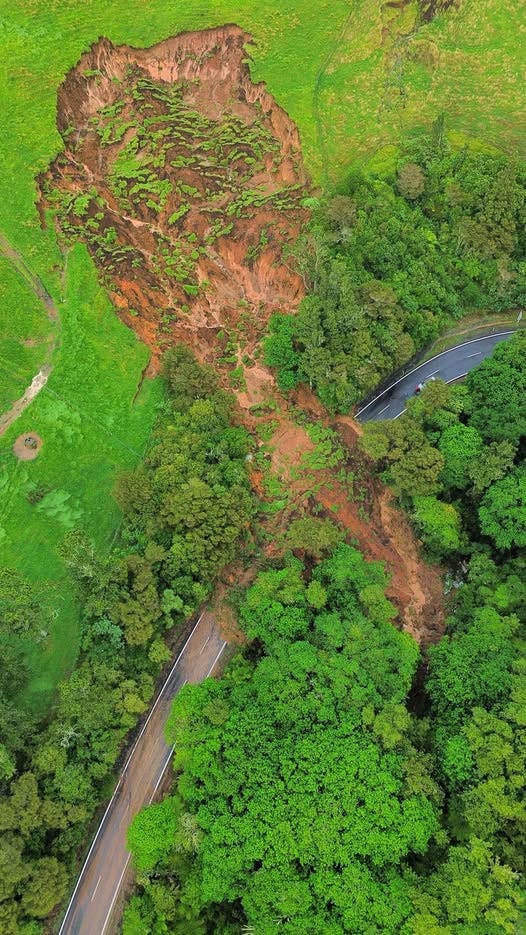
As you are no doubt all well aware by now, the tropical low this week meant that the Coromandel Peninsula along with Northland, the East Coast, and Tauranga all received an extraordinary amount of rain. A red weather warning was issued Wednesday, after two solid days of rain (and yes, my phone going off with the noise and the sound did give me a terrible fright, but boy it sure meant I knew there was a warning in place!) The Coromandel Peninsula flooded extensively. The ground became utterly sodden, and simply couldn’t hold any water, falling off the mountains in multiple places.
Here in Whangamatā, we have been completely shut in since Wednesday, with no passable roads in or out. Local Facebook groups and pages have shared images of flooding and slips, updates from local councils and radio stations have been extremely useful in sharing up-to-date information, and thankfully the power remains on.
We are safe and warm and dry. However, the two of us (12yo and me) are isolated, unable to leave, and the rest of the family unable to join us. We have only a day’s worth of my daughter’s medication left (the husband was to bring some more with him, but with the roads flooded/blocked it has not been possible). I am poorly prepared for a climate emergency during the summer holiday period - our emergency supplies are at home, I have no grab-bag here, our clothing is inadequate for torrential rain, and our medical supplies inadequate. Our social support system and disability-related care needs are not set up for an away-from-home emergency. We will be okay (our GP sent through an urgent script to the local pharmacy, but the past few days has really highlighted that climate related emergencies are coming thick and fast now - and it pays to plan and prepare for both at-home and away-from-home events.
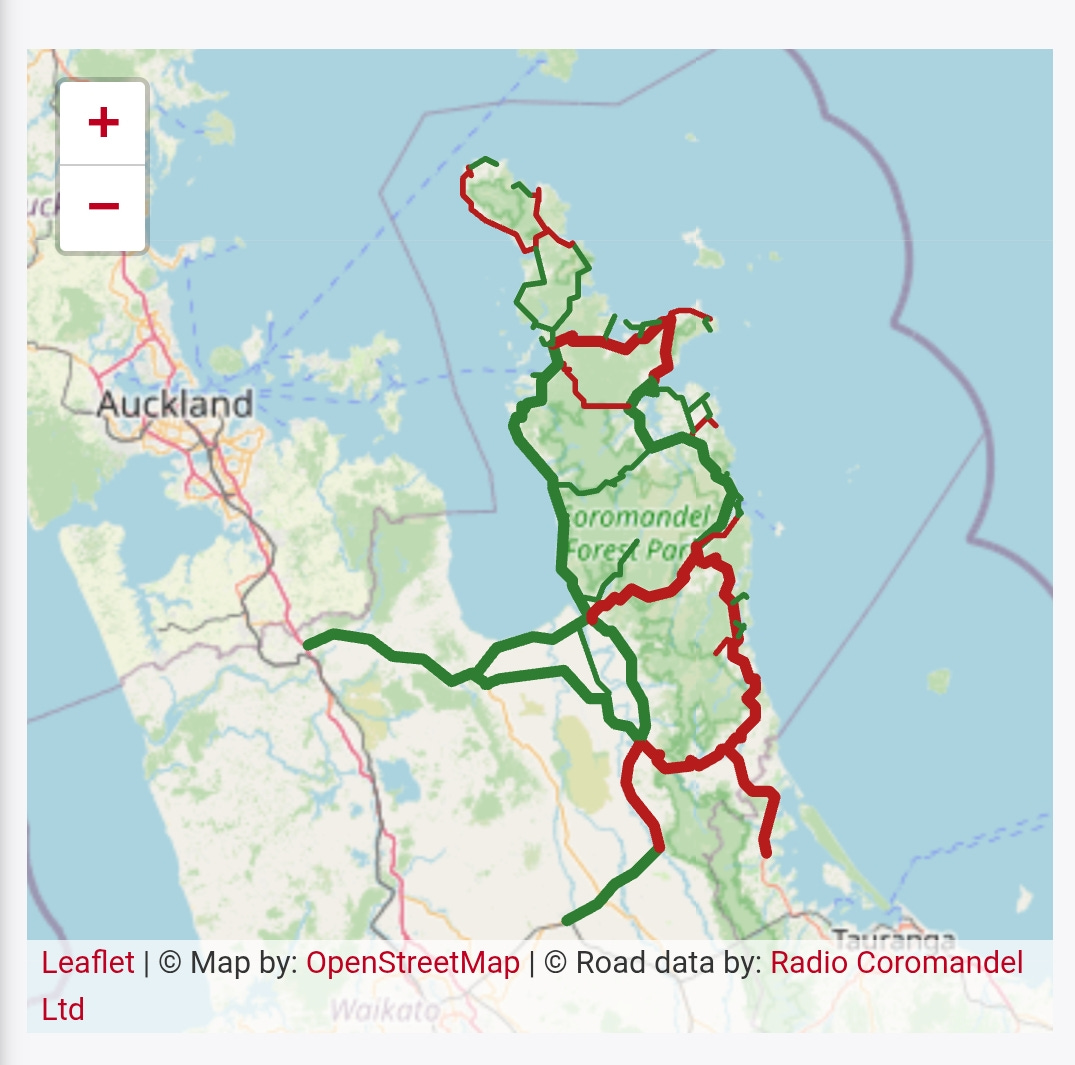
Disability-specific information during this time has not been easy to find. Hauraki District Council has provided updates on Facebook, with both text and video, which has been as accessible as possible (audio, video, captions, and text) under the circumstances. Few others seem to have considered accessibility in their updates (looking at you, Civil Defence). Whangamatā has an accessible beach, but during this emergency there has been next to no disability visibility.
Climate change means that there will be more frequent weather events, and that there will be more wind and rain, more often. We have to plan and prepare - both as a country in terms of ensuring adequate planting on our hills and mountains to hold soil in place, and in planning and building resilient transport and housing to cope with floods, and in our own personal preparation.
Regarding the first two, this current government carelessly threw away billions from the Climate Emergency Response Fund (CERF), established by Labour in 2021. The initial $4.5 billion came from proceeds from the Emissions Trading Scheme (i.e. not taxpayer funds). National closed this fund in their 2024 Budget (presumably to pay for tax cuts?!). The Prime Minister has been notably absent from any of the affected areas. A post of him larking about and having fun with locals at a local Christchurch pub while the North Island was being ravaged by rain, heavy flooding, and slips has not been well received.
The failure of National to prepare for and address climate change, support previously implemented initiatives, or consider alternative forms of transport to roads is well documented. There is no magic solution, but implementing a range of options helps. Savaging cycle lanes and electric cars, refusing to adequately fund public transport, cutting emissions schemes and response funds, increasing oil and gas exploration, and making fun of those who are doing something is poor leadership and even poorer governance. It is deeply frustrating, seeing the effects of tremendous rain, regularly occurring 1-in-a-100 year floods, massive slips and washouts, and the utter refusal by the government to do anything meaningful to address it.
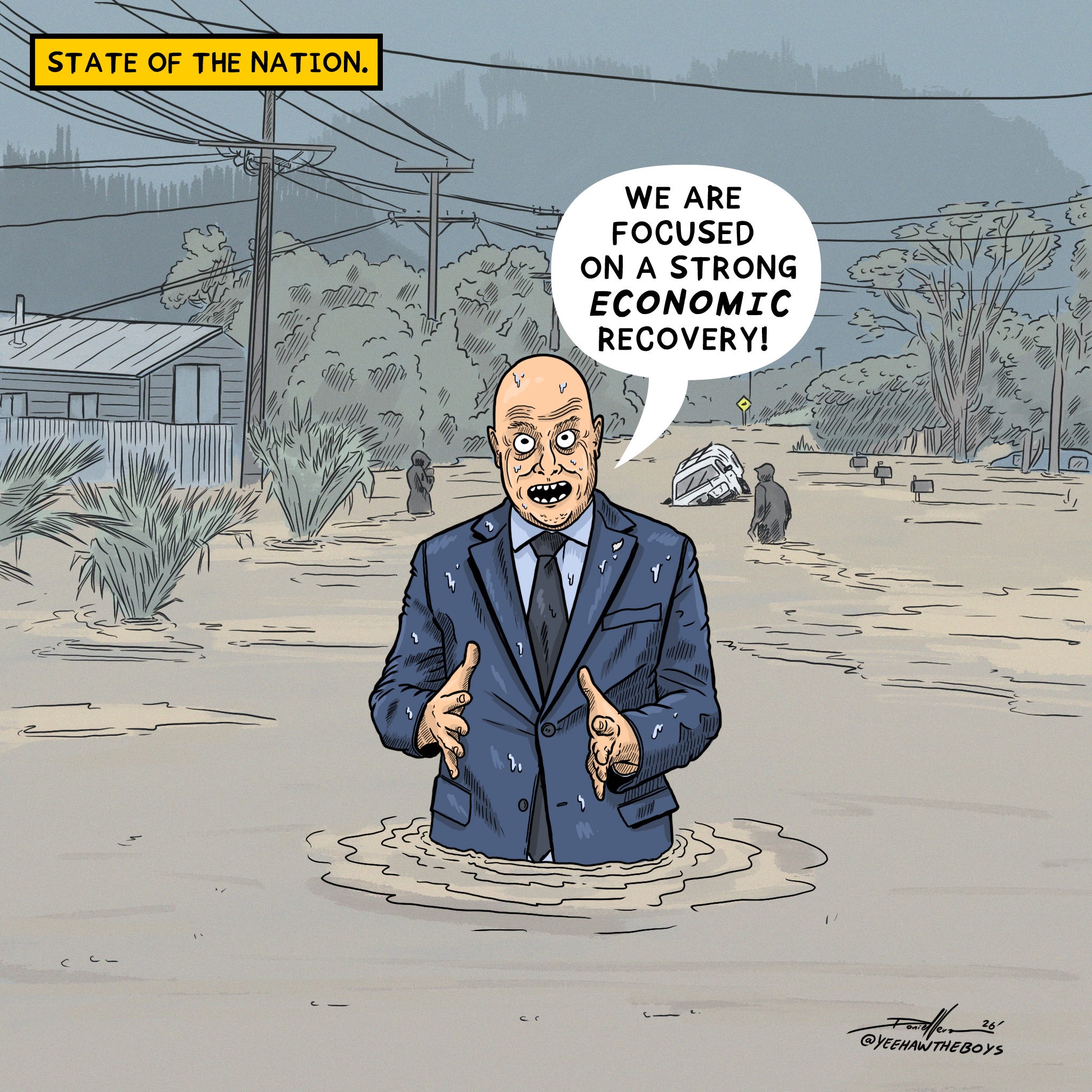
As Daniel Vernon writes,
Luxon keeps pushing for “economic recovery” and “economic independence”, but doesn’t seem to consider that fixing climate change is part of building a strong economy. We can’t keep moving houses to higher land, spending thousands on storm damage and repairs while actively doing nothing to prevent climate change (or actively contributing to making it worse).
As the climate worsens, the damage caused and the price tag to repair it will only rise. The state of our nation is pretty dire, and our Prime Minister giving a speech about economic recovery in a lush business centre after getting back from a “do-not-disturb” holiday is an apt summary of how we got here.
When there is a leadership gap, mis and disinformation abounds. This is currently most obviously seen in local Facebook groups, where any mention of climate change is met with derision, despite locals facing the impacts of increased rain and wind. Claims of '“cloud seeding” - a method which is not used in Aotearoa New Zealand - as a cause for the wet weather abound. Conspiracy theories abound, and, in the face of climate change denial, they are a barrier to action. As David Suzuki writes:
To begin, climate change denial and chemtrails theories are often conspiracy-based. A study by researchers at the University of Western Australia found “endorsement of a cluster of conspiracy theories … predicts rejection of climate science as well as the rejection of other scientific findings.
Many deniers see climate change as a massive plot or hoax perpetrated by the world’s scientists and scientific institutions, governments, the United Nations, environmentalists and sinister forces to create a socialist world government or something.
The problem is that science denial is, in the case of chemtrails, a wacky distraction and, in the case of climate change denial, a barrier to addressing an urgent, critical problem. Science is rarely 100 percent certain, but it’s the best tool we have for coming to terms with our actions and their consequences, and for finding solutions to problems. The science is clear: human-caused climate change is the most pressing threat to humanity, and we must work to resolve it. We don’t have time for debunked conspiracy theories.
That said, before we all fall into the slough of despond, there is a lot we can do. Living by The Stars with Professor Rangi Matamua highlights that looking after the land and looking after the people are intertwined:
Māuiui whenua, māuiui tangata; if the land is sick, its people will follow.
We can encourage local councils to look after the land - they are the local leaders bearing the brunt of disasters and often outlast national election cycles. We can keep making submissions on local and national policies and legislation, even when it feels pointless.
We can plan and prepare - Civil Defence has a great checklist of what to have on hand. Whaikaha has similar information in accessible formats. Christchurch earthquake survivors mention the need for cash - that when the power goes down, EFTPOS becomes unusable and cash is king. Many now keep a cash stash on hand for emergencies. If bad weather is on the way, keep the petrol tank above half way, devices charged, and a grab-bag ready.
We can encourage and support and volunteer with groups that are doing something and advocating for the need for climate responsive approaches. We can share climate adaptation and mitigation information and action on social media (and ignore the conspiracy theorists).
Lastly, this is an election this year. We can vote for parties and representation that will do something about climate mitigation and adaptation.
Please, stay safe. Denying/ignoring the climate crisis is a wonderful example of short-termism and is readily adopted by many who feel they will be sorted ‘this quarter’. With regard to the election I am comforted by the thought that MPs burying their heads in the sand leave another part of their anatomy exposed to their enemies
🙋 Feeling for all those affected by these climate crisis events, particularly those who have lost whanau, friends, homes etc. And your own situation shows that the effects don't have to be visible to be serious ie medications & health treatments being unavailable, even to those "safe" so to speak.🫂 There is no excuse for any govt to ignore/deny/defund climate mitigation action in these times of widespread data. Local govt & communities can do a lot, but central govt should provide leadership AND funding if they are competent & care about their citizens
More learnings from Chch EQ plus being a remote tramper/camper: 1) if water is scarce, have fragrance-free (& preferably bio-degradable?) baby wipes on hand which are efficient alternatives to showers/baths (Antarctic scientists etc camping out on the ice use them too) PLUS can be used to wipe down plates & cutlery & most anything else needed - alternatives are CHUX type clothes dampened & soaped 2) I have an Ecoflow battery pack which can be charged by solar, plug into power, or while driving & I generally use for recharging other things & low draw appliances (incl. portable or even household fridge/freezer) - but remember the "while driving" can also apply to running the car in place to charge phones, batteries etc (with good ventilation obviously) 3) if temporary toilets are needed, old paint cans with lids (designed to be leak proof) or if doing prep in advance, something like the Thunder-down-Under which comes with a built in seat - when travelling I empty these into ordinary toilets or camp toilets when available, and of course after the EQs we had Port-a-loos on the streets for the same. Some people line them with rubbish bags & figure out how to dispose of them later! Ordinary toilet cleaner or diluted White Vinegar or Baking Soda can help with smells & some put kitty litter into the bucket or bag to absorb liquid (in the backcountry I used to use forest litter in the pit toilets) 4) if phone signal is weak, remember txts will go when voice calling doesn't Hopefully we are all learning to be more self-reliant in some ways after being in or witnessing multiple disasters in the last few years alone 🤔
** See the pretend-PM doing media standups a day late & several $$ short, but it got him out of attending Ratana so... 💩🥚🤡